All Exercises
Browse our complete collection of strength training exercises.
Showing 751–780 of 970 exercises
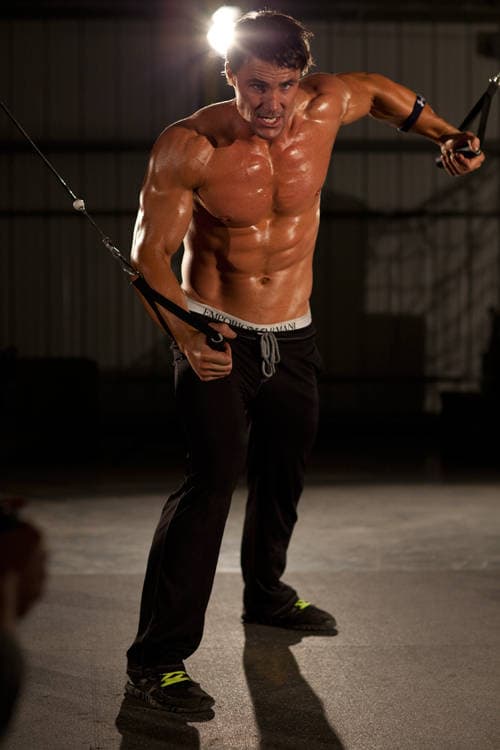
Single-Arm Cable Crossover
Begin by moving the pulleys to the high position, select the resistance to be used, and take a handle in each hand.
Single-Arm Cable Row
A standing single-arm cable row with anti-rotation cueing through the trunk. Distinct from Seated Cable Rows (bilateral seated) and the kneeling/seated single-arm variants — the standing posture loads the contralateral core obliques as they resist rotation, mimicking the trail-side bracing pattern of rotational sports.

Single-Arm Linear Jammer
Position a bar into a landmine or securely anchor it in a corner. Load the bar to an appropriate weight.

Single-Arm Push-Up
Begin laying prone on the ground. Move yourself into a position supporting your weight on your toes and one arm. Your working arm should be placed directly under the shoulder, fully extended. Your legs should be extended, and for this movement you may need a wider base, placing your feet further apart than in a normal push-up.

Single-Cone Sprint Drill
This drill teaches quick foot action. You need a single cone. Begin standing next to the cone with one arm back and one arm forward.

Single Dumbbell Raise
With a wide stance, hold a dumbell with both hands, grasping the head of the dumbbell instead of the handle. Your arms should be extended and hanging at the waist. This will be your starting position.

Single-Leg Balance
An isometric balance hold on one leg. Builds the foot, ankle, and hip proprioception that supports stance-leg stability under fatigue. A foundational drill for runners — every running stride is a brief single-leg stance phase.
Single-Leg Balance Eyes Closed
A proprioception-focused single-leg balance drill that removes visual input to increase balance demand.

Single-Leg Balance on Unstable Surface
A progression of the single-leg balance hold onto an unstable surface (balance pad, BOSU dome, folded pillow, or rolled towel). The instability dramatically increases ankle and foot proprioception demand — the chain that absorbs uneven trail surfaces, tree roots, and rocks on technical terrain.
Single-Leg Box Jump
A single-effort unilateral jump from one foot onto a low or medium-height plyo box, sticking the landing on top with two feet. Trains explosive single-leg power and lead-leg force absorption. Distinct from Single-Leg Hops (continuous lateral plyometric) and Single-Leg Hop Progression (continuous broad-style hops) — this is a single-effort target jump.

Single Leg Butt Kick
Begin by standing on one leg, with the bent knee raised. This will be your start position.
Single-Leg Calf Raise
A unilateral calf raise targeting one side at a time through full range. Uncovers and corrects left-right calf strength imbalances — common in runners after long miles or following an Achilles flare-up. Different stimulus from bilateral Calf Raises (which let the stronger side dominate) and from Eccentric Heel Drop (which is eccentric-only).

Single-Leg Glute Bridge
Unilateral glute activation that exposes and corrects left-right imbalances. More challenging than bilateral bridge.

Single-Leg High Box Squat
Position a box in a rack. Secure a band or rope in place above the box.
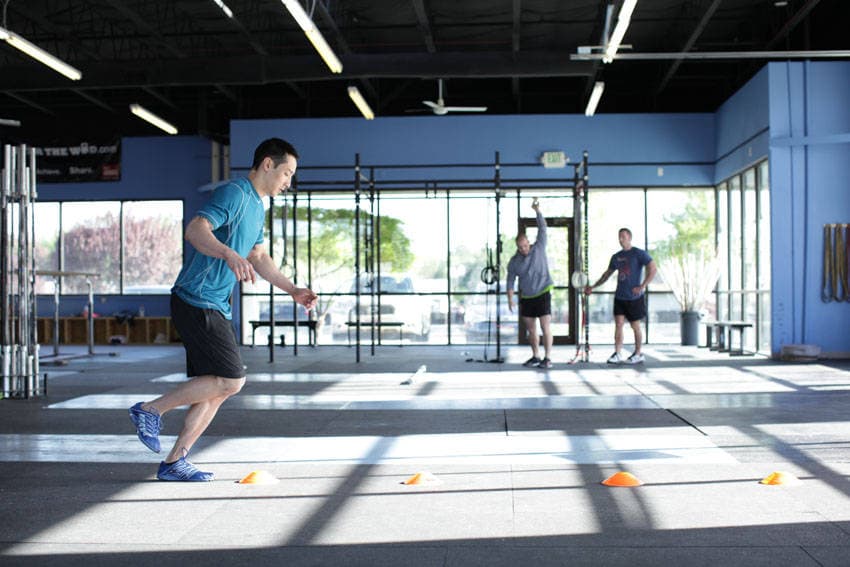
Single-Leg Hop Progression
Arrange a line of cones in front of you. Assume a relaxed standing position, balanced on one leg. Raise the knee of your opposite leg. This will be your starting position.
Single-Leg Hops
A unilateral plyometric drill: continuous hops on one leg in place, training reactive strength and elastic-energy return for each foot strike. Distinct from a single-leg hop progression series (which has multiple variations) — this is repeated single-leg vertical hops with minimal ground-contact time.
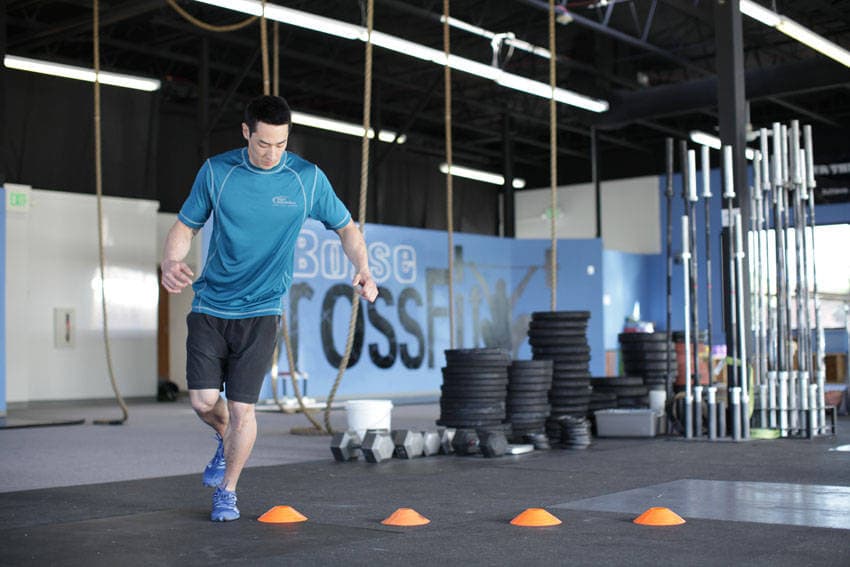
Single-Leg Lateral Hop
Stand to the side of a cone or hurdle. To get into the start position, stand on one leg with your knee slightly bent.

Single-Leg Leg Extension
Seat yourself in the machine and adjust it so that you are positioned properly. The pad should be against the lower part of the shin but not in contact with the ankle. Adjust the seat so that the pivot point is in line with your knee. Select a weight appropriate for your abilities.
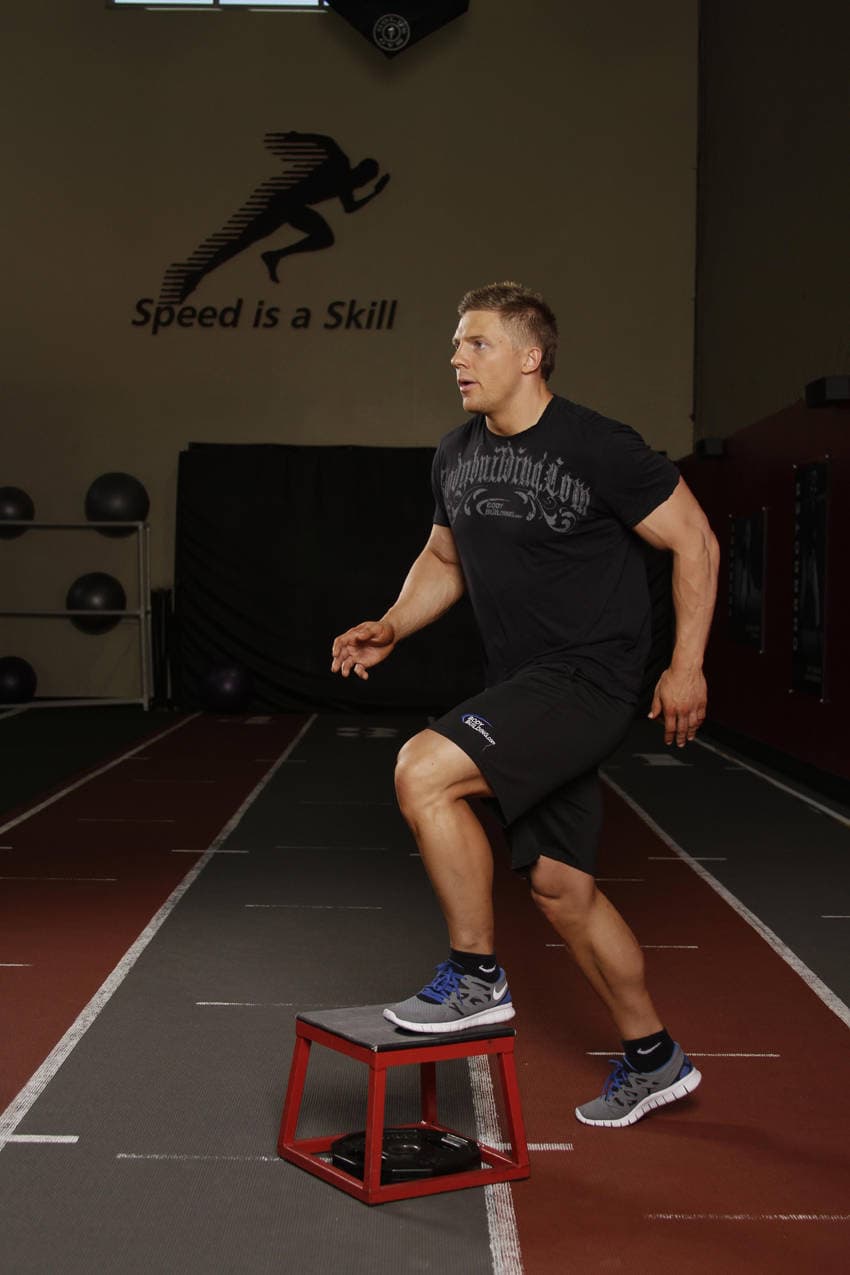
Single Leg Push-off
Stand on the ground with one foot resting on the box, heel close to the edge.
Single-Leg Romanian Deadlift
A unilateral hip-hinge exercise that develops single-leg posterior chain strength, balance, and proprioception. Stronger transfer to running, jumping, and rotational sports than bilateral RDL.

Single-Leg Squat to Box
A unilateral squat where you lower onto a box or bench for depth control. Builds single-leg strength, knee tracking, and balance — a foundational stability drill for runners and any sport built on alternating-leg gait.

Single-Leg Stride Jump
Stand to the side of a box with your inside foot on top of it, close to the edge.

Sit Squats
Stand with your feet shoulder width apart. This will be your starting position.

Sit-Up
Lie down on the floor placing your feet either under something that will not move or by having a partner hold them. Your legs should be bent at the knees.
Skater Hops
A lateral plyometric bound that trains single-leg power, deceleration, and balance through the frontal plane — the reactive lateral strength that underpins cutting, shielding, and change of direction.

Skating
Roller skating is a fun activity which can be effective in improving cardiorespiratory fitness and muscular endurance. It requires relatively good balance and coordination. It is necessary to learn the basics of skating including turning and stopping and to wear protective gear to avoid possible injury.

Sled Drag - Harness
To begin, load the sled with the desired weight and attach the pulling strap. You can pull with handles, use a harness, or attach the pulling strap to a weight belt.

Sledgehammer Swings
You will need a tire and a sledgehammer for this exercise. Stand in front of the tire about two feet away from it with a staggered stance. Grip the sledgehammer.
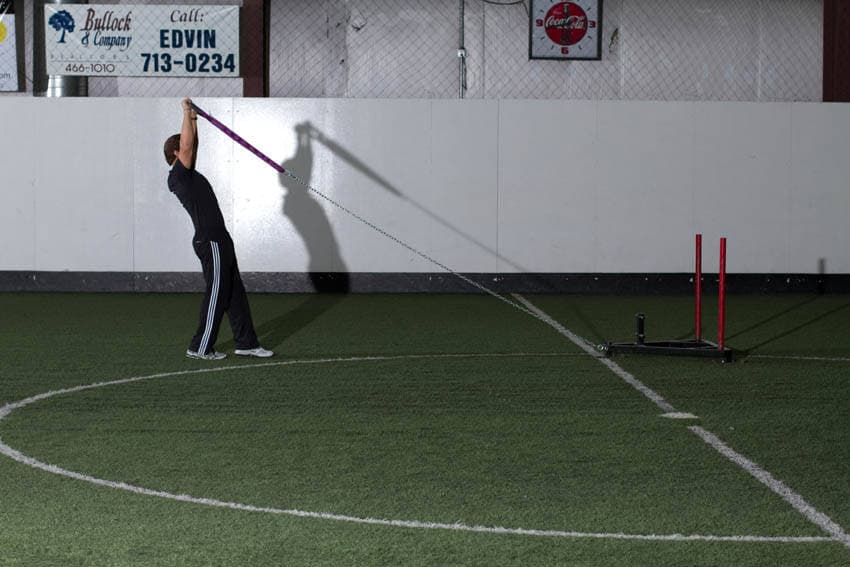
Sled Overhead Backward Walk
Attach dual handles to a sled connected by a rope or chain. Load the sled to a light weight.

Sled Overhead Triceps Extension
Attach dual handles to a sled using a chain or rope. Load the sled to an appropriate load.
Can't find what you need?
Suggest a new exercise