All Exercises
Browse our complete collection of strength training exercises.
Showing 61–90 of 970 exercises
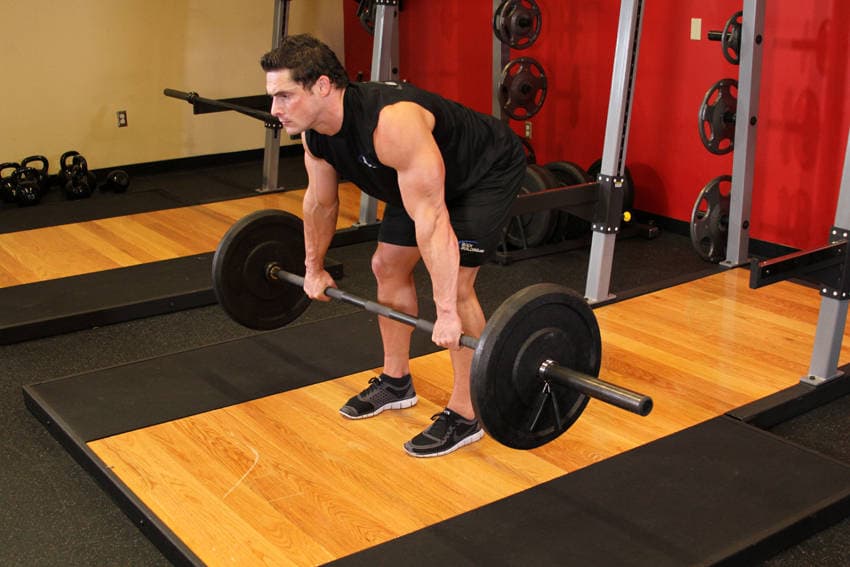
Barbell Rear Delt Row
Stand up straight while holding a barbell using a wide (higher than shoulder width) and overhand (palms facing your body) grip.

Barbell Rollout from Bench
Place a loaded barbell on the ground, near the end of a bench. Kneel with both legs on the bench, and take a medium to narrow grip on the barbell. This will be your starting position.

Barbell Seated Calf Raise
Place a block about 12 inches in front of a flat bench.

Barbell Shrug
Stand up straight with your feet at shoulder width as you hold a barbell with both hands in front of you using a pronated grip (palms facing the thighs). Tip: Your hands should be a little wider than shoulder width apart. You can use wrist wraps for this exercise for a better grip. This will be your starting position.

Barbell Shrug Behind The Back
Stand up straight with your feet at shoulder width as you hold a barbell with both hands behind your back using a pronated grip (palms facing back). Tip: Your hands should be a little wider than shoulder width apart. You can use wrist wraps for this exercise for better grip. This will be your starting position.

Barbell Side Bend
Stand up straight while holding a barbell placed on the back of your shoulders (slightly below the neck). Your feet should be shoulder width apart. This will be your starting position.

Barbell Side Split Squat
Stand up straight while holding a barbell placed on the back of your shoulders (slightly below the neck). Your feet should be placed wide apart with the foot of the lead leg angled out to the side. This will be your starting position.

Barbell Skull Crusher
Lying triceps isolation with a straight barbell. The defining motion is an arc of the bar toward the forehead with elbows fixed.

Barbell Squat
This exercise is best performed inside a squat rack for safety purposes. To begin, first set the bar on a rack to just below shoulder level. Once the correct height is chosen and the bar is loaded, step under the bar and place the back of your shoulders (slightly below the neck) across it.

Barbell Squat To A Bench
This exercise is best performed inside a squat rack for safety purposes. To begin, first place a flat bench or a box behind you. The flat bench is used to teach you to set your hips back and to hit depth.

Barbell Step Ups
Stand up straight while holding a barbell placed on the back of your shoulders (slightly below the neck) and stand upright behind an elevated platform (such as the one used for spotting behind a flat bench). This is your starting position.

Barbell Walking Lunge
Begin standing with your feet shoulder width apart and a barbell across your upper back.

Battle Ropes
For this exercise you will need a heavy rope anchored at its center 15-20 feet away. Standing in front of the rope, take an end in each hand with your arms extended at your side. This will be your starting position.

Bear Crawl Sled Drags
Wearing either a harness or a loose weight belt, attach the chain to the back so that you will be facing away from the sled. Bend down so that your hands are on the ground. Your back should be flat and knees bent. This is your starting position.

Behind Head Chest Stretch
An advanced, partner-assisted PNF (Proprioceptive Neuromuscular Facilitation) stretch for the chest and shoulder complex. It involves an isometric contraction followed by a passive stretch to increase flexibility in the anterior shoulder and pectoral muscles. Requires good baseline shoulder mobility and a communicative partner.

Bench Dips
For this exercise you will need to place a bench behind your back. With the bench perpendicular to your body, and while looking away from it, hold on to the bench on its edge with the hands fully extended, separated at shoulder width. The legs will be extended forward, bent at the waist and perpendicular to your torso. This will be your starting position.

Bench Jump
Begin with a box or bench 1-2 feet in front of you. Stand with your feet shoulder width apart. This will be your starting position.

Bench Press - Powerlifting
The Bench Press - Powerlifting is a maximal strength movement focusing on the chest, shoulders, and triceps. It is a core competition lift in powerlifting, requiring technical precision in setup and execution to safely handle heavy loads.

Bench Press - With Bands
Using a flat bench secure a band under the leg of the bench that is nearest to your head.

Bench Press with Chains
Adjust the leader chain, shortening it to the desired length.Place the chains on the sleeves of the bar.

Bench Sprint
Stand on the ground with one foot resting on a bench or box with your heel close to the edge.

Bent-Arm Barbell Pullover
Lie on a flat bench with a barbell using a shoulder grip width.

Bent-Arm Dumbbell Pullover
Place a dumbbell standing up on a flat bench.

Bent-Knee Hip Raise
The Bent-Knee Hip Raise is a beginner-level core exercise that focuses on isolating the abdominal muscles through a controlled pelvic tilt and hip lift. It effectively trains the rectus abdominis while minimizing lower back strain by keeping the knees bent.
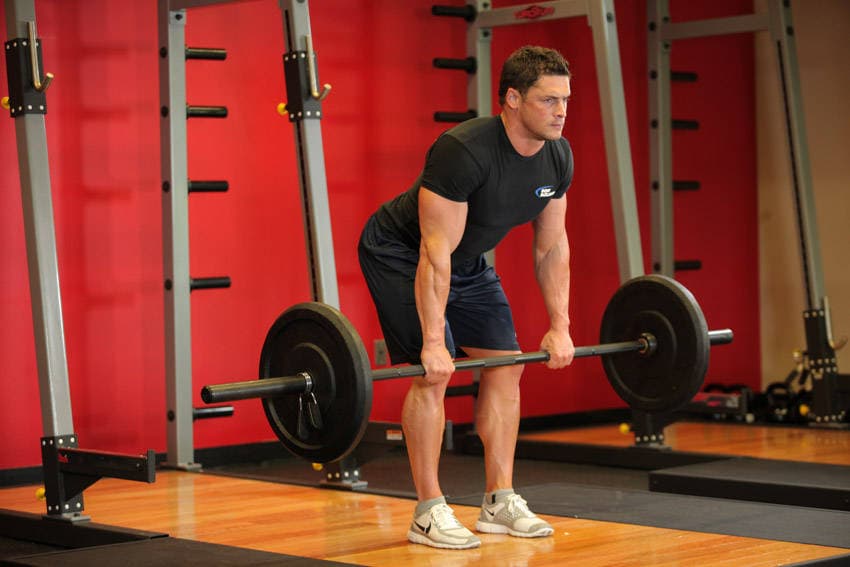
Bent Over Barbell Row
Holding a barbell with a pronated grip (palms facing down), bend your knees slightly and bring your torso forward, by bending at the waist, while keeping the back straight until it is almost parallel to the floor. Tip: Make sure that you keep the head up. The barbell should hang directly in front of you as your arms hang perpendicular to the floor and your torso. This is your starting position.
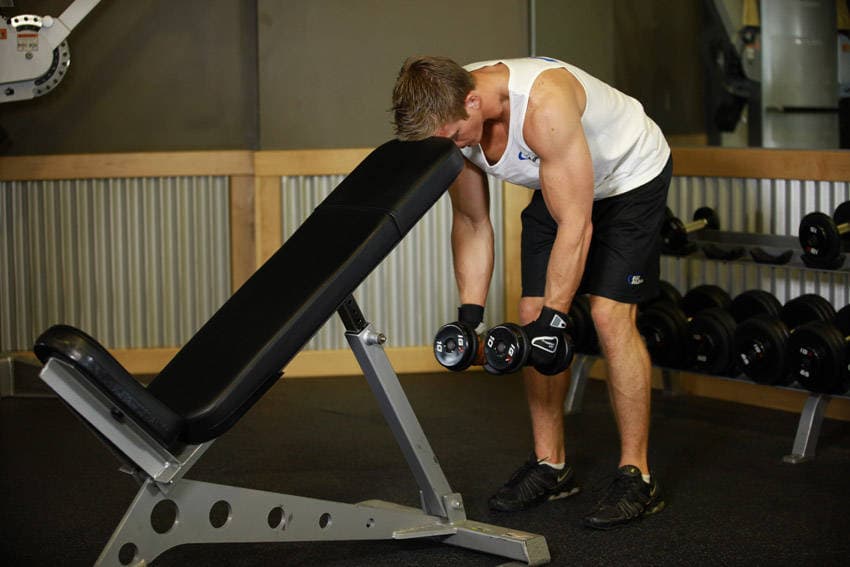
Bent Over Dumbbell Rear Delt Raise With Head On Bench
Stand up straight while holding a dumbbell in each hand and with an incline bench in front of you.
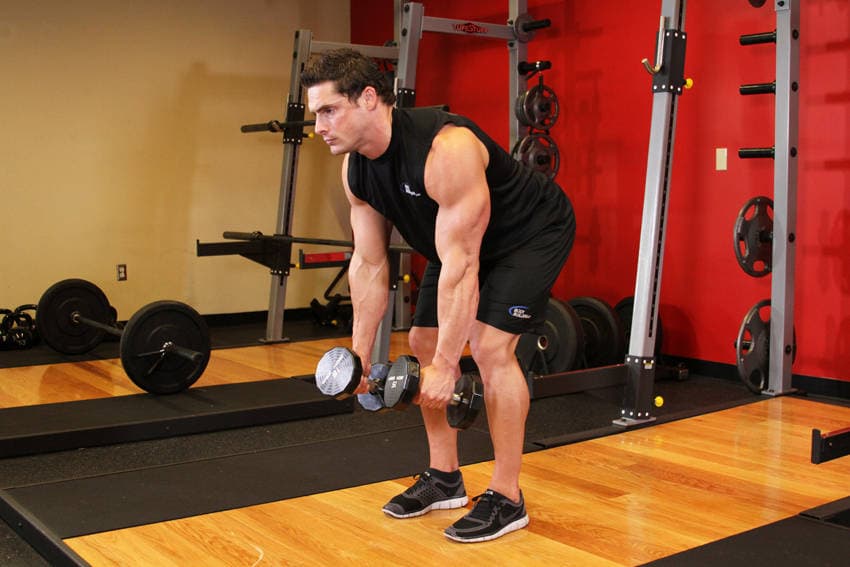
Bent Over Dumbbell Row
With a dumbbell in each hand (palms facing your torso), bend your knees slightly and bring your torso forward by bending at the waist; as you bend make sure to keep your back straight until it is almost parallel to the floor. Tip: Make sure that you keep the head up. The weights should hang directly in front of you as your arms hang perpendicular to the floor and your torso. This is your starting position.

Bent Over Low-Pulley Side Lateral
The Bent Over Low-Pulley Side Lateral is a unilateral isolation exercise that targets the shoulder muscles, specifically the medial deltoids, from a bent-over position. This cable variation provides constant tension throughout the range of motion, helping to develop shoulder width and stability.

Bent Over One-Arm Long Bar Row
Put weight on one of the ends of an Olympic barbell. Make sure that you either place the other end of the barbell in the corner of two walls; or put a heavy object on the ground so the barbell cannot slide backward.
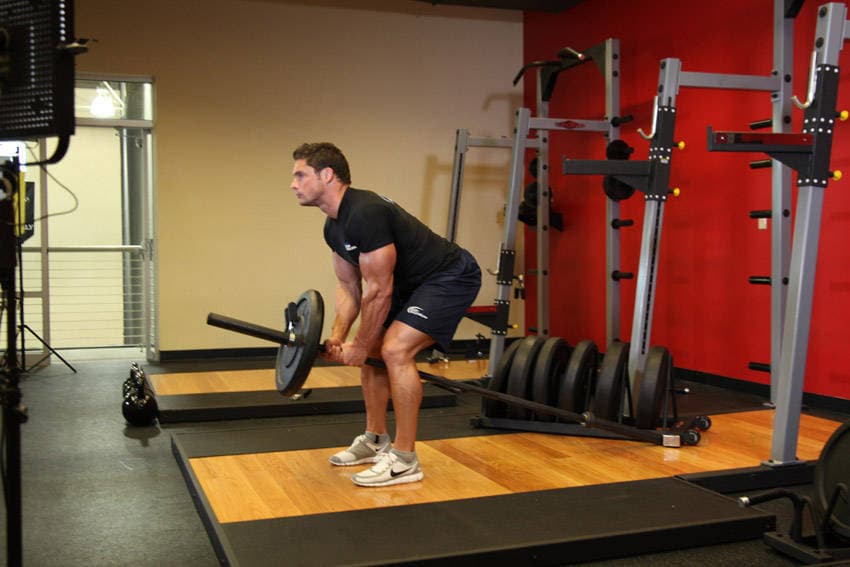
Bent Over Two-Arm Long Bar Row
Put weight on one of the ends of an Olympic barbell. Make sure that you either place the other end of the barbell in the corner of two walls; or put a heavy object on the ground so the barbell cannot slide backward.
Can't find what you need?
Suggest a new exercise