Beginner Exercises
Perfect for those new to strength training.
Showing 271–300 of 573 exercises

Lateral Cone Hops
Position a number of cones in a row several feet apart.

Lateral Lunge
A lateral-plane lunge that trains single-leg strength in the frontal plane — balancing the typical sagittal-plane lunge work and developing the hip mobility/strength critical for athletic side-to-side movement.

Lateral Raise - With Bands
To begin, stand on an exercise band so that tension begins at arm's length. Grasp the handles using a pronated (palms facing your thighs) grip that is slightly less than shoulder width. The handles should be resting on the sides of your thighs. Your arms should be extended with a slight bend at the elbows and your back should be straight. This will be your starting position.

Latissimus Dorsi-SMR
While lying on the floor, place a foam roll under your back and to one side, just behind your arm pit. This will be your starting position.
Lat Pulldown
A standard cable-machine vertical pull for training the lats and upper back. This generic canonical represents the normal front lat pulldown used in strength and hypertrophy programming, without forcing a specific wide, close, single-arm, or behind-neck grip variant.

Leg Extensions
For this exercise you will need to use a leg extension machine. First choose your weight and sit on the machine with your legs under the pad (feet pointed forward) and the hands holding the side bars. This will be your starting position. Tip: You will need to adjust the pad so that it falls on top of your lower leg (just above your feet). Also, make sure that your legs form a 90-degree angle between the lower and upper leg. If the angle is less than 90-degrees then that means the knee is over th
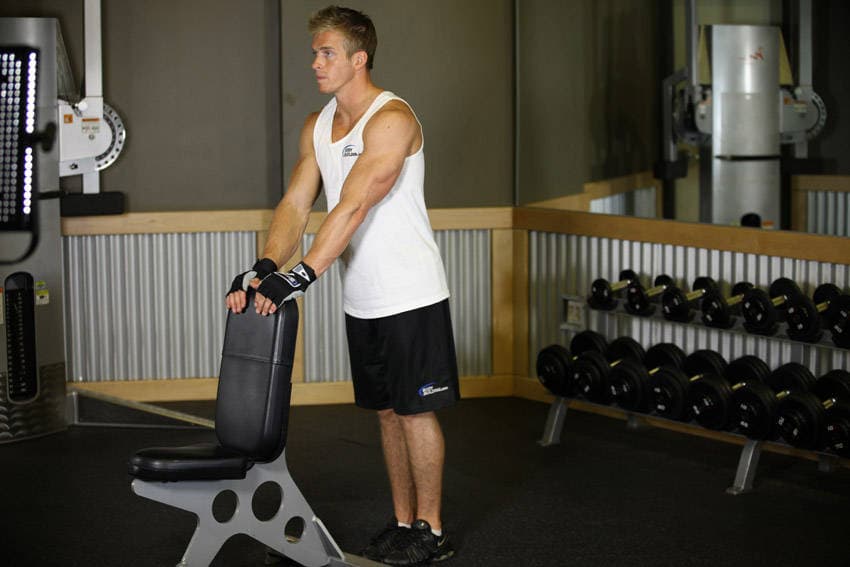
Leg Lift
While standing up straight with both feet next to each other at around shoulder width, grab a sturdy surface such as the sides of a squat rack or the top of a chair to brace yourself and keep balance.

Leg Press
Using a leg press machine, sit down on the machine and place your legs on the platform directly in front of you at a medium (shoulder width) foot stance. (Note: For the purposes of this discussion we will use the medium stance described above which targets overall development; however you can choose any of the three stances described in the foot positioning section).

Leg Pull-In
Lie on an exercise mat with your legs extended and your hands either palms facing down next to you or under your glutes. Tip: My preference is with the hands next to me. This will be your starting position.
Leg Swings — Front to Back
Dynamic hip flexor and hamstring mobility. Progressively increases range of motion with each swing through the sagittal plane.

Leg Swings — Side to Side
Dynamic hip adductor and abductor mobility. Opens the frontal plane range of motion needed for squats and lateral stability.

Leg-Up Hamstring Stretch
Lie flat on your back, bend one knee, and put that foot flat on the floor to stabilize your spine.

Leverage Chest Press
Load an appropriate weight onto the pins and adjust the seat for your height. The handles should be near the bottom or middle of the pectorals at the beginning of the motion.

Leverage Deadlift
Load the pins to an appropriate weight. Position yourself directly between the handles. Grasp the bottom handles with a comfortable grip, and then lower your hips as you take a breath. Look forward with your head and keep your chest up. This will be your starting position.

Leverage Decline Chest Press
Load an appropriate weight onto the pins and adjust the seat for your height. The handles should be near the bottom of the pectorals at the beginning of the motion. Your chest and head should be up and your shoulder blades retracted. This will be your starting position.

Leverage High Row
Load an appropriate weight onto the pins and adjust the seat height so that you can just reach the handles above you. Adjust the knee pad to help keep you down. Grasp the handles with a pronated grip. This will be your starting position.

Leverage Incline Chest Press
Load an appropriate weight onto the pins and adjust the seat for your height. The handles should be near the top of the pectorals at the beginning of the motion. Your chest and head should be up and your shoulder blades retracted. This will be your starting position.

Leverage Iso Row
Load an appropriate weight onto the pins and adjust the seat height so that the handles are at chest level. Grasp the handles with either a neutral or pronated grip. This will be your starting position.

Leverage Shoulder Press
Load an appropriate weight onto the pins and adjust the seat for your height. The handles should be near the top of the shoulders at the beginning of the motion. Your chest and head should be up and handles held with a pronated grip. This will be your starting position.

Leverage Shrug
Load the pins to an appropriate weight. Position yourself directly between the handles.

Linear 3-Part Start Technique
This drill helps you accelerate as quickly as possible into a sprint from a dead stop. It helps to use a line to start from. Begin with two feet on the line. Place your left foot with the toe next to your right ankle. Place your right foot 4-6 inches behind the left.

Linear Acceleration Wall Drill
Lean at around 45 degrees against a wall. Your feet should be together, glutes contracted.

Looking At Ceiling
Kneel on the floor, holding your heels with both hands.

Low Cable Crossover
To move into the starting position, place the pulleys at the low position, select the resistance to be used and grasp a handle in each hand.

Low Cable Triceps Extension
Select the desired weight and lay down face up on the bench of a seated row machine that has a rope attached to it. Your head should be pointing towards the attachment.

Lower Back Curl
Lie on your stomach with your arms out to your sides. This will be your starting position.

Lower Back-SMR
In a seated position, place a foam roll under your lower back. Cross your arms in front of you and protract your shoulders. This will be your starting position.

Low Pulley Row To Neck
Sit on a low pulley row machine with a rope attachment.

Lying Cambered Barbell Row
Place a cambered bar underneath an exercise bench.
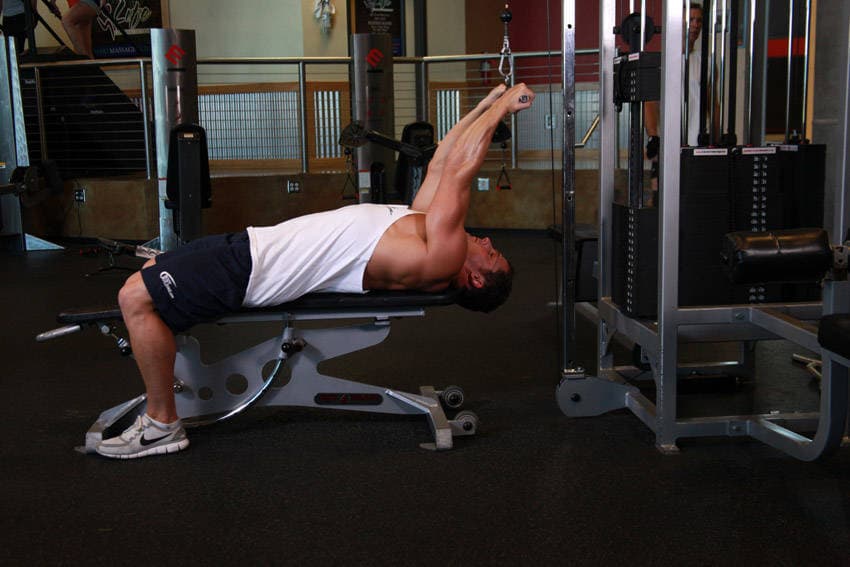
Lying Close-Grip Bar Curl On High Pulley
Place a flat bench in front of a high pulley or lat pulldown machine.
Can't find what you need?
Suggest a new exercise